




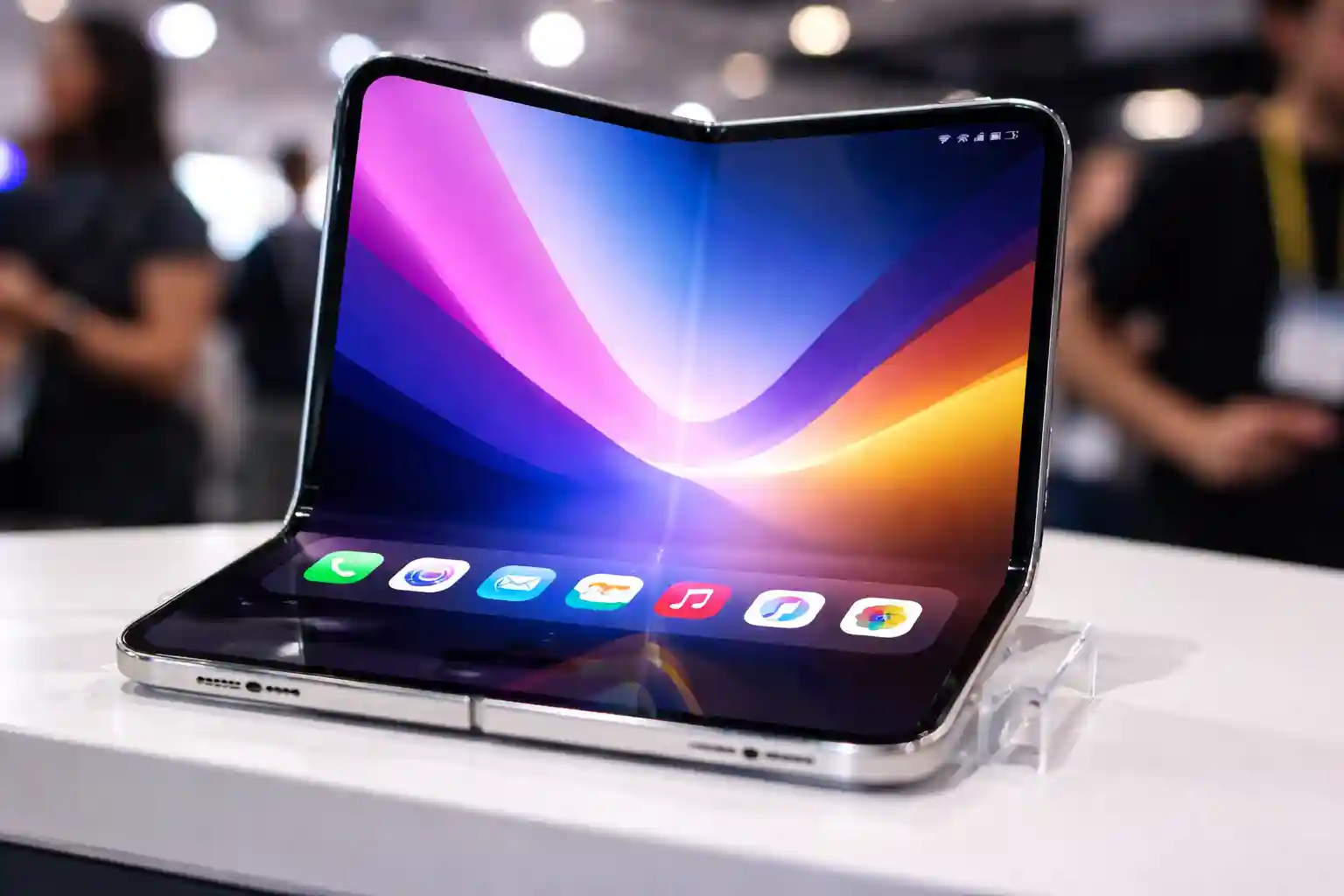
At the annual Consumer Electronics Show (CES) 2026 in Las Vegas, an exciting prototype display has caught the attention of tech enthusiasts worldwide: a crease-free foldable OLED panel that could be used in Apple’s first foldable iPhone. Demonstrated by Samsung Display, the prototype screen appears to significantly reduce or even eliminate the visible crease that has long plagued foldable devices, renewing anticipation that Apple’s long-rumored foldable smartphone is finally nearing reality.
- Breaking the Foldable Crease Barrier
- What Makes the New Display Different?
- Apple’s Rumored Foldable iPhone
- Implications for Foldable Smartphone Market
- Competition and the Future of Foldables
- User Experience and Durability Considerations
- What’s Next for Apple’s Foldable Device?
- Conclusion: A New Chapter for Foldables
Breaking the Foldable Crease Barrier
Foldable smartphones have steadily risen in popularity over the past decade, offering the promise of a large, tablet-like screen that folds into a more compact phone form. However, a persistent issue with current foldable screens — such as those seen on Samsung’s Galaxy Z Fold models — has been the visible crease running down the center of the display where the screen bends. While recent iterations have reduced this crease, it remains visible at certain angles.
This year at CES 2026, Samsung Display showcased a new “Advanced Crease-less” foldable OLED panel that appeared to eliminate this visible crease entirely. Attendees noted seamless text and graphics across the fold, regardless of viewing angle, suggesting a smooth, uninterrupted surface that could significantly improve the user experience for foldable devices.
What Makes the New Display Different?
The key innovation behind the crease-free display appears to be a combination of engineering improvements within the panel’s internal structure. Samsung Display’s prototype reportedly uses a laser-drilled metal plate beneath the OLED surface that helps disperse the mechanical stress that typically causes visible folding lines. By evenly distributing this stress, the panel maintains a flatter, more continuous surface, even when folded.
In addition to eliminating the crease, some versions of the prototype include an in-display selfie camera, maximizing screen real estate and reducing the need for cutouts or notches. This feature highlights how foldable display technology is rapidly evolving, pushing toward more immersive and seamless user experiences.
Apple’s Rumored Foldable iPhone
While Samsung Display demonstrated the panel, speculation is high that this technology could underpin Apple’s anticipated foldable iPhone — often referred to in rumors as the “iPhone Fold”. Industry analyst Ming-Chi Kuo has previously suggested that Apple’s first foldable phone will use a similar crease-reducing structure supplied by Samsung’s panel division, combined with Apple’s own design tweaks.
Rumors suggest the foldable iPhone will feature a book-style design, with an internal screen measuring around 7.5 to 7.8 inches when open, and a cover display of about 5.3 to 5.5 inches when closed — offering a tablet-like experience in a pocket-friendly form factor. Analysts also note that Apple may forgo Face ID for the interior screen in favor of Touch ID embedded in the power button, optimizing the device design for foldable form factors.
Despite growing excitement, Samsung quickly pulled the prototype display from its CES booth, leading some observers to conclude that the panel remains in an experimental phase rather than ready for mass production. Samsung representatives reportedly described the panel as an R&D concept rather than a finalized product with a confirmed commercial release timeline.
Read More

Implications for Foldable Smartphone Market
If crease-free panels become widely available, they could usher in a new era of foldable devices. The visible crease has been one of the biggest consumer complaints about foldables, with many users reporting that it distracts from video watching, reading and gaming. By eliminating or minimizing that crease, manufacturers can offer a more refined and cohesive display experience.
Analysts believe that such advancements could accelerate the adoption of foldable devices, attracting users who have been hesitant due to durability concerns or the visual imperfection of existing screens. In turn, this may encourage a broader range of manufacturers to invest in foldable phone technology and differentiate with unique features like under-display cameras or improved hinge mechanics.
Competition and the Future of Foldables
Samsung — already a leader in foldable displays — is expected to integrate this creaseless panel into future versions of its own Galaxy Z Fold lineup, potentially debuting in the upcoming Galaxy Z Fold 8 later in 2026. Meanwhile, Apple’s entry into the foldable market could significantly reshape competitive dynamics, leveraging its brand ecosystem and software optimization to challenge established Android manufacturers.
Other smartphone makers, including Motorola and Huawei, have also explored foldable designs, with various approaches to hinge mechanics and display durability. However, none have yet matched the seamless aesthetic promised by the new prototype panel showcased at CES.
User Experience and Durability Considerations
While initial impressions of the crease-free prototype have been positive, practical concerns remain regarding long-term durability and real-world usability. Foldable phones must endure repeated opening and closing, and how well these displays hold up over years of use will be critical to consumer confidence. The use of laser-drilled metal plates and advanced stress dispersal may improve longevity, but manufacturers will need to conduct extensive testing before mainstream adoption.
Additionally, foldable phones still command higher prices compared to traditional smartphones, due in part to the complexity of their displays and hinge mechanisms. Eliminating the crease could help justify premium pricing by providing a display quality closer to rigid OLED screens, which have become the standard for high-end devices.
What’s Next for Apple’s Foldable Device?
Although there’s no official announcement from Apple regarding the launch date for a foldable iPhone, industry reports suggest that mass production could begin in the second half of 2026, with a potential release around September alongside other flagship devices. Whether Apple integrates the exact prototype seen at CES — or a modified version designed in collaboration with Samsung — remains to be seen.
As foldable screen technology continues to improve, Apple and its partners are likely to refine key elements like hinge design, screen resilience, and battery efficiency to deliver a product that meets consumer expectations for both performance and aesthetics.
Conclusion: A New Chapter for Foldables
The crease-free foldable OLED panel spotted at CES 2026 represents a significant milestone in display technology and hints at what could be a breakthrough innovation for Apple’s first foldable iPhone. By addressing one of the most persistent limitations of current foldables, manufacturers may unlock a broader market appeal and push the form factor toward mainstream adoption. While challenges remain before such devices hit consumer hands, the excitement generated at CES suggests that the future of foldable smartphones is closer than ever — and potentially more seamless than we’ve ever seen.